
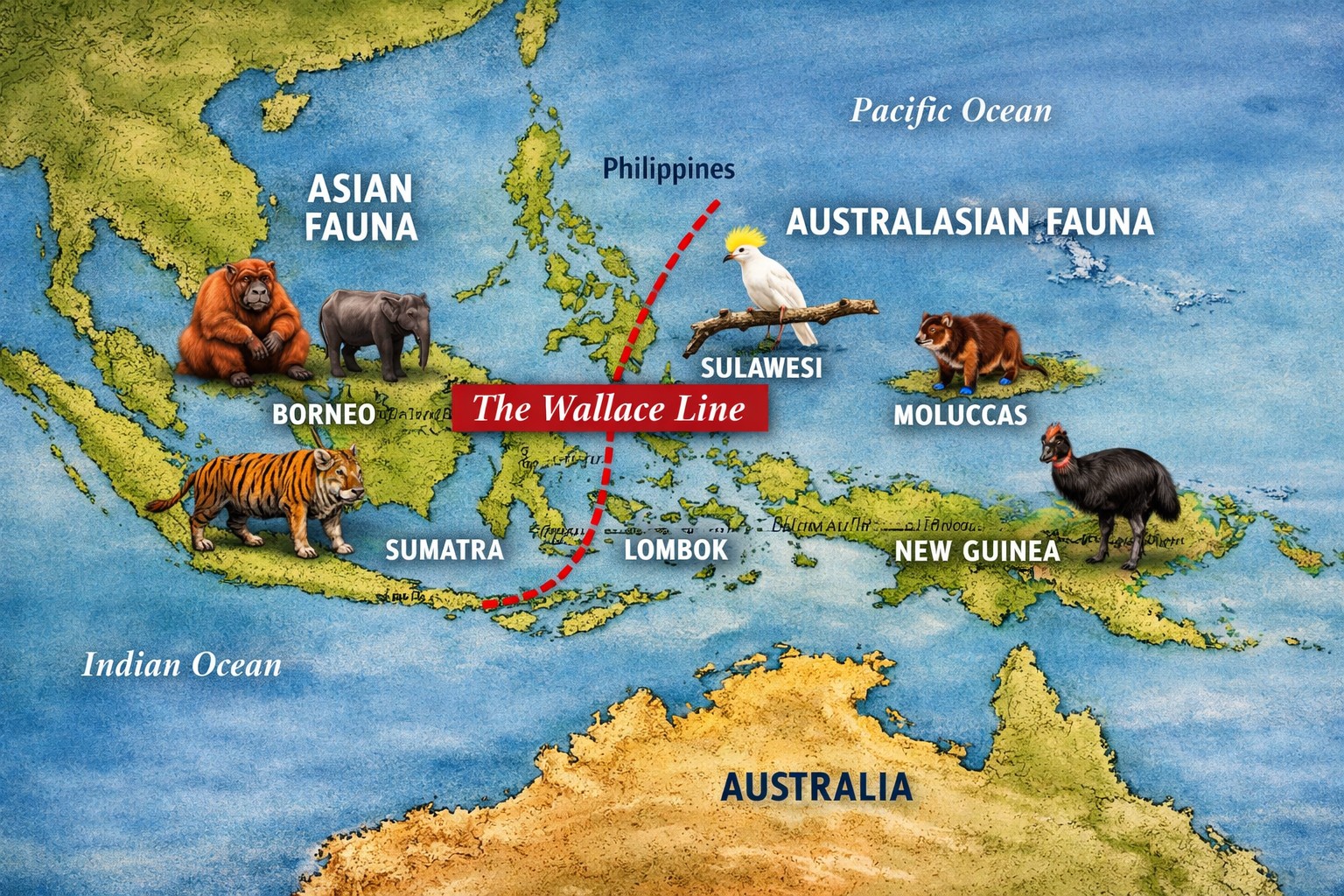
Wallace Line
A Natural Boundary of Biodiversity
The Wallace Line is one of the most significant biogeographical boundaries in the world, delineating a striking difference between the flora and fauna of Asia and Australasia. It was first identified by Alfred Russel Wallace, a British naturalist and contemporary of Charles Darwin, during his explorations of Southeast Asia and the Malay Archipelago in the mid-19th Century.
The Wallace Line runs between Bali and Lombok in the Indonesian Archipelago, extending northward between Borneo and Sulawesi and further southeast between the islands of Timor and New Guinea. What makes the Wallace Line so fascinating is the sharp contrast in biodiversity on either side, despite the relative proximity of the islands. To the west of the line the species are typically Asian in origin where mammals like tigers, rhinoceros and elephants are native to islands like Sumatra and Borneo. The vegetation on these islands is also similar to the forests found in mainland Southeast Asia. On the other hand, to the east of the Wallace Line the species are predominantly Australasian, sharing more in common with Australia and New Guinea. Marsupials, such as tree kangaroos and cuscuses and birds like cockatoos are commonly found in this region.
This striking biodiversity divide is primarily due to geological and evolutionary history. The Wallace Line represents the boundary between two tectonic plates: The Sunda Shelf to the west and the Sahul Shelf to the east. During the Ice Ages, when sea levels were lower, the Sunda Shelf was part of mainland Asia, allowing land-based animals and plants to migrate freely between the two regions. Meanwhile, the Sahul Shelf was connected to Australia and New Guinea, enabling the migration of Australasian species. However, deep ocean trenches between these two continental shelves prevented the easy migration of species across the Wallace Line, maintaining the distinction between the biotas of the two regions even after sea levels rose and the islands become isolated.
Wallace’s observations were fundamental in developing the field of biogeography, which studies the distribution of species and ecosystems through geographical space and over geological time. He was struck by the fact that Bali, which is located just a short distance from Lombok (35 km), had species that resembled those of mainland Asia, while Lombok’s species were more similar to those in New Guinea and Australia. The difference was too stark to be explained by distance alone, leading Wallace to infer the existence of a significant biogeographical boundary.
Text by Heritage Expeditions.
Leave a Reply